
- Introduction: Why Grok AI Is Changing Language Learning
- Why Use Grok Instead of Traditional Language Apps?
- How to Use Grok AI Prompts Correctly
- 1. Outcome-First Language Plan Prompt
- 2. High-Frequency Core Vocabulary Prompt
- 3. Natural Sentence Formation Prompt
- 4. Real-World Conversation Role-Play Prompt
- 5. Casual vs Formal Language Prompt
- 6. Common Beginner Mistakes Prompt
- 7. Thinking in the Language Prompt
- 8. Pronunciation Without Audio Prompt
- 9. Everyday Native Phrases Prompt
- 10. Grammar Without Jargon Prompt
- Best Daily Routine Using Grok AI Prompts
- Who Should Use Grok as a Language Coach?
- Final Thoughts: Grok AI Prompts Is a Tool—Prompts Are the Power
Introduction: Why Grok AI Is Changing Language Learning
Most language learners fail for one simple reason—they learn the language but never learn how to use it.
Apps focus on streaks, games, and memorization. Textbooks focus on rules. But real fluency comes from thinking, speaking, and reacting naturally in the language.
That’s where Grok AI Prompts change everything.
Instead of acting like a teacher, Grok behaves more like a real conversation partner and personal language coach. With the right prompts, you can practice real-world conversations, fix common mistakes, and develop native-level thinking—without paying for expensive courses.
In this guide, I’ll share 10 powerful Grok AI prompts that transform Grok into your free AI language coach, along with insights on why they work and how to use them effectively.
Why Use Grok Instead of Traditional Language Apps?
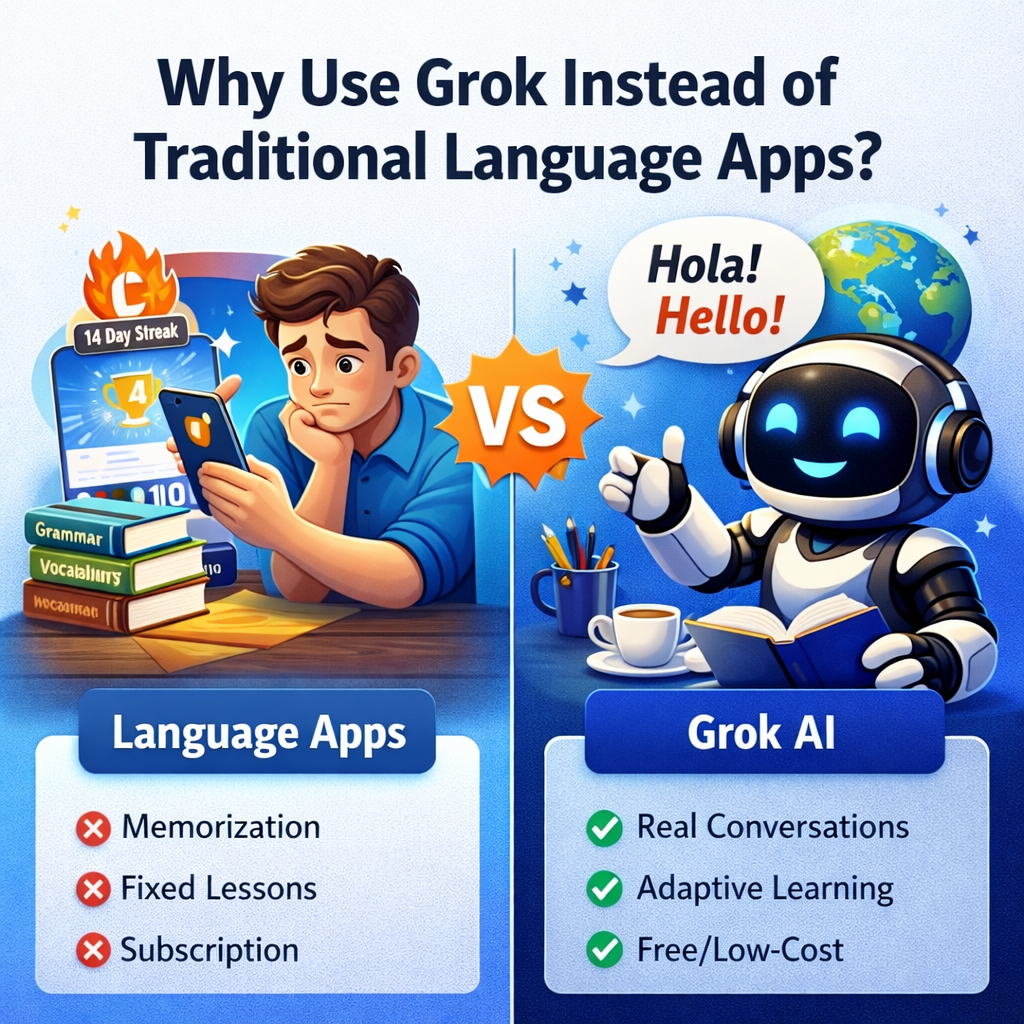
Before jumping into prompts, let’s quickly compare.
Traditional Apps vs Grok AI
| Feature | Language Apps | Grok AI |
|---|---|---|
| Focus | Memorization | Real communication |
| Learning Style | Fixed lessons | Adaptive conversations |
| Speaking Practice | Limited | Unlimited |
| Personalization | Low | High |
| Cost | Subscription-based | Free / Low-cost |
Unlike apps, Grok lets you control the learning direction. You decide what to practice, how deep to go, and when to correct mistakes.
This flexibility is why Grok AI prompts are so powerful.
More Updates:-
- AI-Generated Movies in 2026: The Beginning of a New Era in Filmmaking
- Faceless.video Explained: Automated Video Creation Made Simple
- Open AI UpdatesOpenAI Deep Research & New Version Details
- 2026 Guide: How to Start Earning with AI and Build a Profitable Business
- Free Legal Movie Streaming with ChatGPT: 7 Powerful Prompts to Turn Your Laptop into a Home Cinema
- Why 2026 Is the Best Time to Build Mobile Apps with AI for Online Earning
- YouTube was built on creators. Today, it’s being flooded by AI-generated volume with no value.
- How to Make Money with AI: 7 Proven Methods + Complete Step-by-Step Roadmap (2025 Guide)
- Unlock AI Power Now: Top 10 AI Tools in 2025 A Proven Beginner’s Roadmap to Mastery
- Perplexity Score in AI: How It Works and Why It Matters (2025 Guide)
How to Use Grok AI Prompts Correctly
Before the prompts, one important rule:
Use Grok as a coach, not as a translator.
That means:
- Speak or type full thoughts
- Ask for corrections
- Request explanations in simple language
Now let’s dive into the prompts.
1. Outcome-First Language Plan Prompt
Prompt
“My goal is to use this language confidently for daily conversations. Create a 30-day plan focused only on speaking, listening, and understanding real conversations. Avoid textbook lessons.”
Why This Works
Most learners start with grammar. This Grok AI Prompts starts with real-life outcomes—the exact way fluent speakers learn.
Pro Tip
Follow the plan verbally, not silently. Speak everything out loud.
2. High-Frequency Core Vocabulary Prompt
Prompt
“Teach me the most commonly used words and phrases in daily conversations. Include pronunciation tips and how natives shorten them.”
Why This Works
According to linguistic research, 20% of words cover nearly 80% of conversations. This prompt filters noise and teaches only what matters.
You can verify this principle through resources like linguistic frequency studies from Oxford Learner’s Dictionaries or Cambridge Language Research.
3. Natural Sentence Formation Prompt
Prompt
“Help me form short, natural sentences people actually use. Explain word order simply, without grammar terms.”
Why This Works
Native speakers don’t think in rules—they think in patterns. This prompt trains pattern recognition instead of memorization.
4. Real-World Conversation Role-Play Prompt
Prompt
“Role-play a real conversation at a café. Speak naturally and pause so I can reply. Correct me gently.”
Why This Works
This simulates real pressure—thinking and responding instantly. It’s far more effective than passive learning.
5. Casual vs Formal Language Prompt
Prompt
“Show how natives say this casually, neutrally, and formally. Explain when each is used.”
Why This Works
Fluency isn’t just about correctness—it’s about context awareness. This prompt prevents awkward or robotic speech.
6. Common Beginner Mistakes Prompt
Prompt
“List common beginner mistakes in daily conversations. Show wrong vs correct examples.”
Why This Works
Awareness kills bad habits early. Many learners repeat mistakes for years simply because nobody points them out.
7. Thinking in the Language Prompt
Prompt
“Help me express this idea the way a native would think it, not by translating from English.”
Why This Works
Translation is the biggest fluency killer. This prompt retrains your mental structure, not just vocabulary.
8. Pronunciation Without Audio Prompt
Prompt
“Explain pronunciation using mouth position, stress, and rhythm without audio.”
Why This Works
Surprisingly effective for learners without constant listening access. It builds physical awareness of sound production.
9. Everyday Native Phrases Prompt
Prompt
“Teach phrases natives use daily, including fillers and shortcuts.”
Why This Works
Real conversations rely on fillers like “you know,” “kind of,” “actually”. These are rarely taught—but essential.
10. Grammar Without Jargon Prompt
Prompt
“Explain this grammar idea using plain language and real examples only.”
Why This Works
Grammar becomes intuitive when tied to usage, not terminology.
Best Daily Routine Using Grok AI Prompts
Here’s a simple structure:
| Time | Activity |
|---|---|
| 10 min | Vocabulary prompt |
| 15 min | Sentence building |
| 20 min | Conversation role-play |
| 5 min | Error review |
Consistency beats intensity.
Who Should Use Grok as a Language Coach?
- Beginners who hate textbooks
- Working professionals
- Travelers
- Content creators
- Anyone practicing English or foreign languages
If you can type or speak—you can learn.
conversational AI and large language models
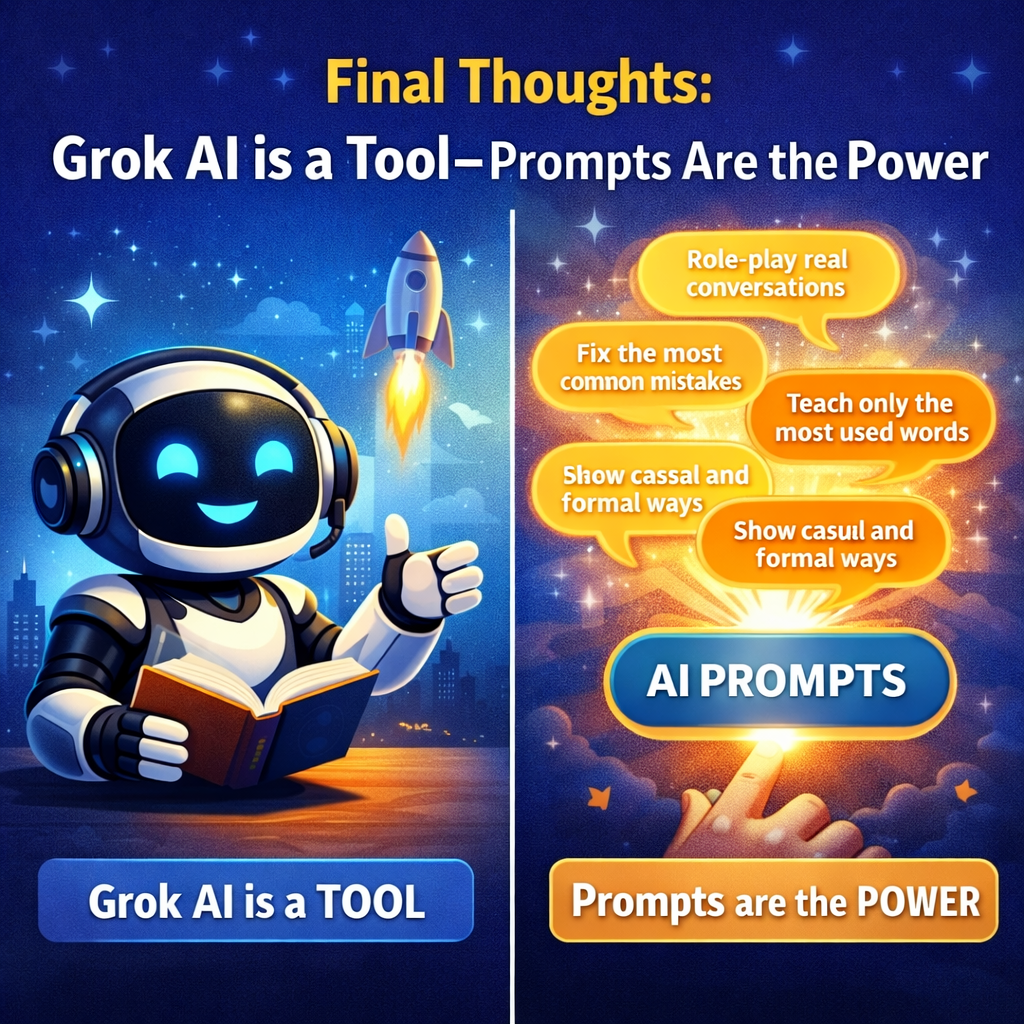
Final Thoughts: Grok AI Prompts Is a Tool—Prompts Are the Power
Grok itself isn’t magic.
The prompts are.
With the right Grok AI prompts, you can:
- Learn faster
- Speak naturally
- Think like a native
- Avoid common mistakes
This approach aligns closely with modern AI-assisted learning models discussed in AI research platforms like MIT Technology Review and conversational AI insights from xAI’s official research blog.