
- Introduction: A Bold Prediction About the Future of Human Work
- A Historical Comparison: Every Revolution Redefined Work
- What Does “Meaningful Work” Really Mean?
- Where AI Is Already Replacing Human Roles
- Key Insight #1: AI Eliminates Tasks, Not Entire Professions
- Key Insight #2: The Rise of Human-AI Collaboration
- Key Insight #3: The Real Risk Is Skill Obsolescence
- Table: Skills at Risk vs Skills in Demand
- The Psychological Angle: Meaning Beyond Productivity
- Will 2026 Be the Tipping Point?
- A Balanced Conclusion: End or Evolution?
- Preparing for the Future of Human Work
Introduction: A Bold Prediction About the Future of Human Work
What if 2026 becomes the year we look back on as the moment human work fundamentally changed?
In recent discussions about artificial intelligence, bold claims have emerged suggesting that we are approaching a tipping point. The future of human work is no longer a distant academic debate — it is unfolding in real time.
Automation is no longer limited to factories. AI now writes content, generates code, produces videos, analyzes legal contracts, and even assists in medical diagnostics. According to the World Economic Forum’s Future of Jobs Report, 44% of workers’ skills will be disrupted within five years due to AI and automation.
So the real question isn’t whether AI will change work.
It’s whether it will redefine what “meaningful” work even means.
A Historical Comparison: Every Revolution Redefined Work
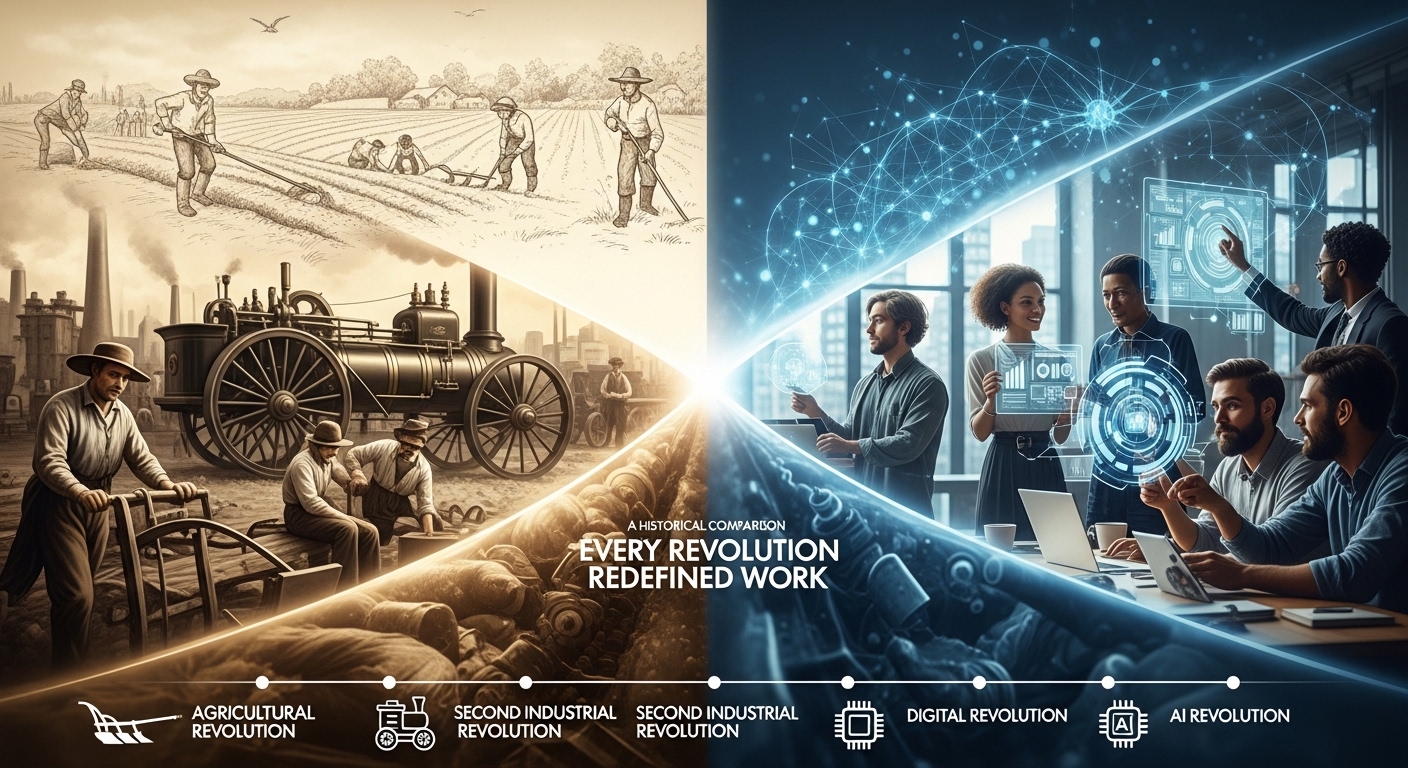
Throughout history, technology has disrupted labor markets:
| Industrial Shift | What Changed | Human Impact |
|---|---|---|
| Industrial Revolution | Machines replaced manual labor | Productivity increased |
| Computer Revolution | Software automated clerical tasks | Knowledge work expanded |
| Internet Era | Global digital economy | Remote work & platforms emerged |
| AI Revolution | Cognitive automation | Creative & strategic roles at risk |
The difference now?
AI is not just automating physical tasks — it is automating cognitive tasks.
The McKinsey Global Institute estimates that up to 30% of work hours globally could be automated by 2030. This is not a minor shift. It affects writers, designers, analysts, marketers, and even programmers.
For the first time, machines are encroaching on what we once considered uniquely human capabilities.
- Perplexity Score in AI: How It Works and Why It Matters (2025 Guide)
- 40 Jobs AI Can’t Replace (Yet): A Reality Check from Microsoft’s Research
- How to Use Gemini AI + Google Search Data to Build a Profitable Side Hustle in 2026
- Why 2026 Is the Best Time to Build Mobile Apps with AI for Online Earning
- AI Side Hustles You Can Start in 2025 (With Zero Investment) – Complete Guide
- GitHub Copilot (2025 Guide): Features, Pricing, and How to Make Money Using It
- Ways to Earn Money with AI in
- Latest AI News Around the World
- Free Legal Movie Streaming with ChatGPT: 7 Powerful Prompts to Turn Your Laptop into a Home Cinema
- Unlock AI Power Now: Top 10 AI Tools in 2025 A Proven Beginner’s Roadmap to Mastery
What Does “Meaningful Work” Really Mean?
Before we assume humans will stop doing meaningful work, we must define it.
Traditionally, meaningful work has included:
- Problem-solving
- Creativity
- Decision-making
- Emotional intelligence
- Leadership
- Craftsmanship
AI already handles structured problem-solving and content generation. Tools like large language models can draft business strategies, generate marketing campaigns, and write software code in seconds.
But here’s the nuance: AI generates. Humans contextualize.
The future of human work may shift from execution to judgment.
Where AI Is Already Replacing Human Roles
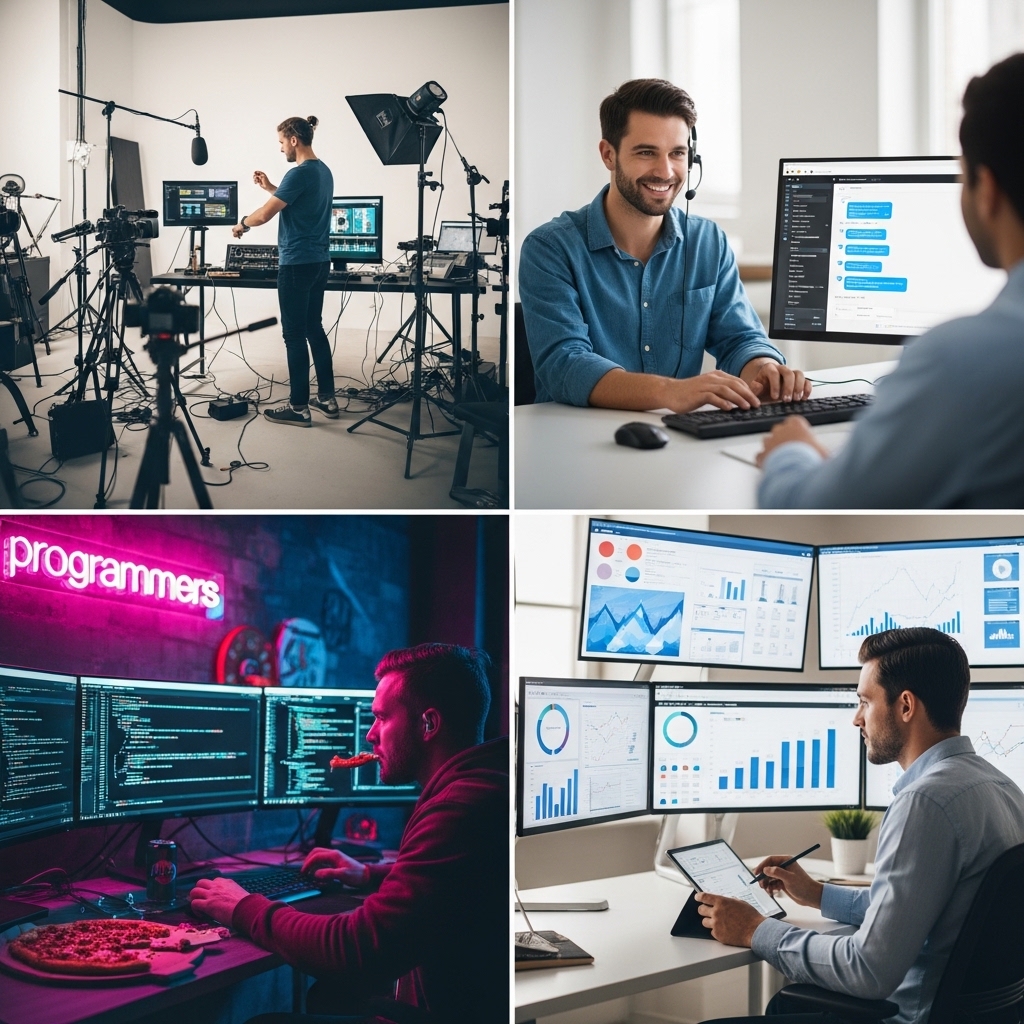
Let’s examine sectors experiencing rapid AI penetration.
1. Content & Media
AI systems now generate blogs, scripts, product descriptions, and images. Companies are reducing freelance budgets and replacing entry-level roles with automation tools.
2. Customer Support
Chatbots and AI-driven help desks now handle a majority of first-line support queries, reducing the need for human agents.
3. Programming
AI coding assistants can generate entire application frameworks, cutting development time dramatically.
4. Data Analysis
AI tools can process datasets faster than human analysts and identify patterns instantly.
This doesn’t mean total elimination — but it means fewer humans are needed for the same output.
Key Insight #1: AI Eliminates Tasks, Not Entire Professions
Historically, technology eliminates repetitive tasks — not entire industries.
For example:
- ATMs didn’t eliminate banks.
- E-commerce didn’t eliminate retail.
- Spreadsheets didn’t eliminate accountants.
Instead, roles evolved.
The same may happen with AI. Instead of replacing marketers, AI may replace manual marketing workflows. Instead of replacing doctors, AI may replace diagnostic inefficiencies.
The future of human work becomes higher leverage.
Key Insight #2: The Rise of Human-AI Collaboration
A growing number of companies are adopting hybrid systems where humans supervise AI output.
According to Stanford HAI, productivity increases significantly when humans and AI collaborate rather than compete.
This suggests a shift from:
Human vs Machine → Human + Machine
In this model:
- AI handles speed and scale.
- Humans handle strategy and ethics.
The meaningful work may shift toward oversight, design, system-building, and innovation.
Key Insight #3: The Real Risk Is Skill Obsolescence
The biggest threat is not job elimination.
It is skill irrelevance.
Routine cognitive tasks are being automated. Workers who fail to adapt may face displacement. But those who build complementary skills — strategic thinking, system design, AI literacy — gain exponential leverage.
In short:
AI rewards adaptability.
Table: Skills at Risk vs Skills in Demand
| Skills at Risk | Skills in Demand |
|---|---|
| Repetitive data entry | AI system design |
| Basic content writing | Strategic storytelling |
| Routine coding | AI architecture & review |
| Manual reporting | Data interpretation |
| Administrative scheduling | Workflow automation |
The future of human work will reward those who build around AI rather than compete with it.
The Psychological Angle: Meaning Beyond Productivity

Here’s something rarely discussed.
Work has always been tied to identity.
If AI performs most measurable tasks better and faster, humans may struggle with purpose.
This is where society faces a deeper question:
If productivity is automated, what becomes the human role?
Possibilities include:
- Creativity without economic pressure
- Relationship-based industries
- Research and exploration
- Personal brand and digital entrepreneurship
Meaning may detach from employment and attach to contribution.
Will 2026 Be the Tipping Point?
Is 2026 truly the “last year” humans do meaningful work?
Probably not in absolute terms.
But it may represent a symbolic shift — where AI becomes deeply embedded in daily operations across industries.
Indicators pointing toward acceleration:
- Rapid advancements in generative AI
- Enterprise AI adoption rates increasing
- Venture capital heavily funding AI startups
- Governments drafting AI regulations
According to PwC’s AI analysis, AI could contribute up to $15.7 trillion to the global economy by 2030.
That scale of transformation inevitably reshapes labor markets.The Real Transformation: From Worker to System Builder
In the coming decade, the highest leverage individuals will:
- Build AI-powered systems
- Own digital assets
- Design automated workflows
- Monetize intellectual property
Instead of selling time, they will design systems that scale.
This marks a fundamental evolution in the future of human work — from labor to leverage.
A Balanced Conclusion: End or Evolution?
Human work is unlikely to disappear.
But it will evolve dramatically.
Repetitive execution will decline. Strategic design will rise.
The next few years may feel destabilizing. But they also offer unprecedented opportunity for those willing to adapt.
Meaningful work will not vanish.
It will migrate.
The real question is:
Will you migrate with it?
World Economic Forum – Future of Jobs Report:
Preparing for the Future of Human Work
If you want to stay relevant:
- Learn how AI tools operate
- Develop critical thinking skills
- Focus on creativity and strategic execution
- Build digital systems instead of depending solely on jobs
The shift is already happening.
2026 may not be the end of meaningful work — but it may be the end of traditional work.