
- Introduction: The Real Gap Between human vs artificial intelligence
- Intelligence vs Curiosity: A Difference We Rarely Talk About(human vs artificial intelligence)
- Why AI Cannot Ask Fundamental Questions
- human vs artificial intelligence: A Practical Comparison
- The Illusion of Independent AI Thinking
- Why Curiosity Is the Source of All Breakthroughs(human vs artificial intelligence)
- AI as a Multiplier, Not a Mind
- The Future of human vs artificial intelligence Collaboration
- Why This Matters for Creators, Businesses, and Students(human vs artificial intelligence)
- The Danger of Outsourcing Curiosity
- Conclusion: Intelligence Is Not Enough(human vs artificial intelligence)
Introduction: The Real Gap Between human vs artificial intelligence
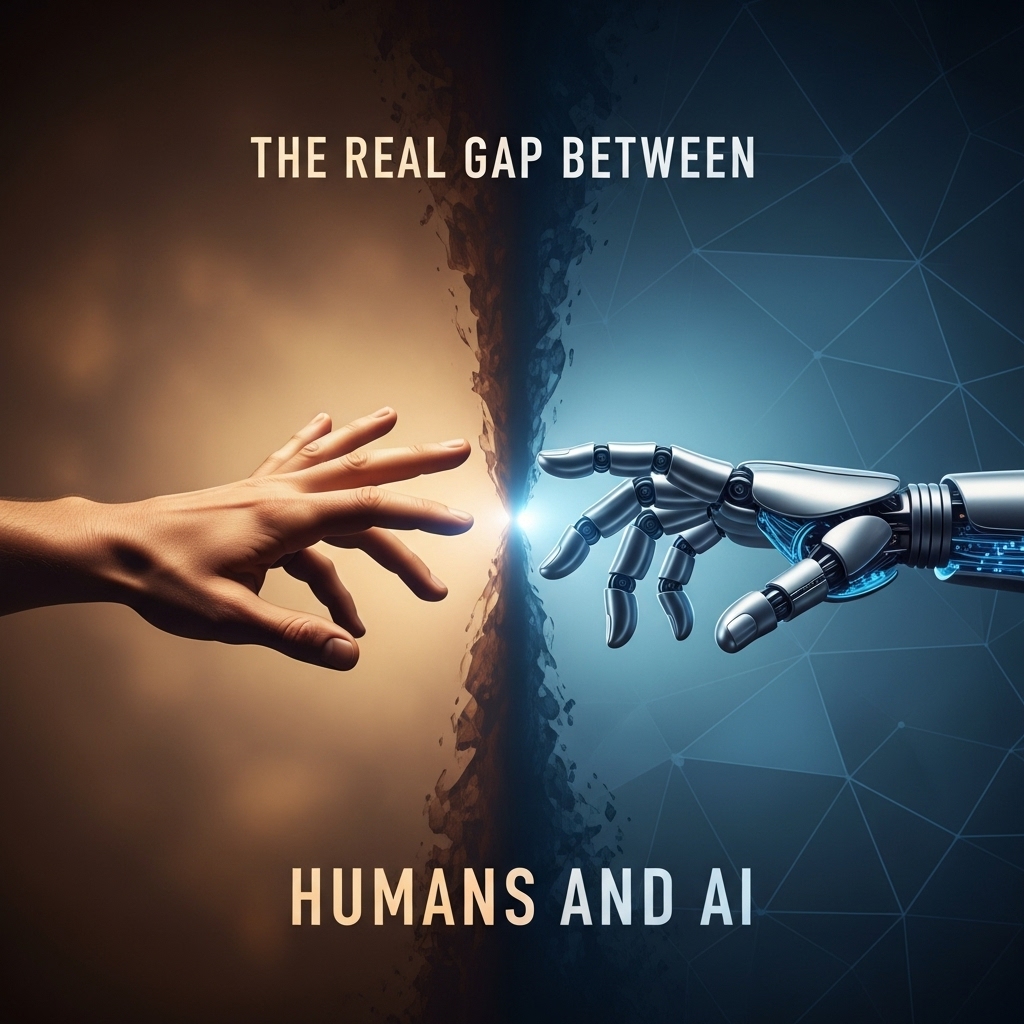
Human vs artificial intelligence is one of the most important discussions in today’s digital world. Artificial intelligence is everywhere—it writes content, analyzes markets, generates code, predicts behavior, and even mimics conversation. At first glance, it feels like machines are getting closer to human thinking every day.
But there is a crucial difference we often ignore.
The debate around human vs artificial intelligence is not about how fast AI can process information or how accurately it can predict outcomes. The real gap lies deeper—in curiosity. AI has intelligence, but it does not have curiosity. And that single limitation changes everything.
AI can answer questions brilliantly. What it cannot do is decide which questions are worth asking in the first place.
That responsibility still belongs to humans, and this is exactly what defines the true meaning of human vs artificial intelligence.
More Updates:-
- Perplexity Score in AI: How It Works and Why It Matters (2025 Guide)
- 40 Jobs AI Can’t Replace (Yet): A Reality Check from Microsoft’s Research
- How to Use Gemini AI + Google Search Data to Build a Profitable Side Hustle in 2026
- Why 2026 Is the Best Time to Build Mobile Apps with AI for Online Earning
- AI Side Hustles You Can Start in 2025 (With Zero Investment) – Complete Guide
- GitHub Copilot (2025 Guide): Features, Pricing, and How to Make Money Using It
- Ways to Earn Money with AI in
- Latest AI News Around the World
- Free Legal Movie Streaming with ChatGPT: 7 Powerful Prompts to Turn Your Laptop into a Home Cinema
- Unlock AI Power Now: Top 10 AI Tools in 2025 A Proven Beginner’s Roadmap to Mastery
Intelligence vs Curiosity: A Difference We Rarely Talk About(human vs artificial intelligence)

Intelligence and curiosity are often treated as the same thing. They are not.
What Intelligence Really Means
Intelligence, in its simplest form, is the ability to:
- Process information
- Recognize patterns
- Optimize outcomes
- Solve clearly defined problems
Modern AI systems excel at this. In many narrow tasks, they outperform humans.
What Curiosity Actually Is
Curiosity is different. It is the drive to:
- Question assumptions
- Explore the unknown without a clear reward
- Ask “why” instead of “how”
- Seek meaning, not just answers
Curiosity is messy, emotional, and often irrational. It does not follow datasets or predefined goals. It emerges from lived experience.
This is where the human vs artificial intelligence divide becomes impossible to ignore.
Why AI Cannot Ask Fundamental Questions

AI does not wake up wondering how the world works. It does not feel confusion. It does not experience doubt. It does not seek purpose.
As Aravind Srinivas, CEO of Perplexity, has pointed out in interviews, AI systems can solve problems once they are defined — but humans always define the problem first.
That is not a technical limitation. It is a philosophical one.
AI systems:
- Do not have intrinsic motivation
- Do not generate curiosity-driven questions
- Do not challenge the goals they are given
They optimize within boundaries. Humans decide what those boundaries are.
human vs artificial intelligence: A Practical Comparison
| Aspect | Humans | Artificial Intelligence |
|---|---|---|
| Curiosity | Innate and emotional | Absent |
| Question Formation | Self-generated | Prompt-dependent |
| Meaning Creation | Core strength | Not possible |
| Problem Solving | Contextual and intuitive | Data-driven and logical |
| Ethical Judgment | Experience-based | Rule-based |
| Creativity | Originates ideas | Recombines patterns |
This table reveals a truth often overlooked in AI hype cycles. AI is not replacing human thinking. It is amplifying human intent.
The Illusion of Independent AI Thinking

Many people assume AI systems “think” because their outputs feel intelligent. But what we are witnessing is advanced pattern recognition, not independent reasoning.
AI does not:
- Decide what matters
- Question the validity of its goals
- Reflect on consequences unless instructed
Every AI output is shaped by:
- Training data chosen by humans
- Objectives defined by humans
- Constraints enforced by humans
In the human vs artificial intelligence discussion, this distinction is critical. Intelligence without curiosity is powerful, but directionless.
Why Curiosity Is the Source of All Breakthroughs(human vs artificial intelligence)
Every major human breakthrough began with a question, not an answer.
- Why does gravity exist?
- What causes disease?
- Can machines think?
- What is consciousness?
These questions did not emerge from data analysis. They emerged from human curiosity, frustration, and imagination.
AI can help explore answers faster. But it cannot generate the original spark.
Without curiosity:
- Science stagnates
- Innovation becomes incremental
- Progress loses meaning
This is why humans remain essential, regardless of how advanced AI becomes.
AI as a Multiplier, Not a Mind
The most productive way to frame AI is not as a replacement for humans, but as a multiplier of human curiosity.
When humans ask better questions:
- AI delivers better insights
- AI uncovers deeper patterns
- AI accelerates meaningful discovery
When humans ask shallow or misguided questions:
- AI produces shallow outputs
- Optimization leads to noise
- Scale amplifies mistakes
The quality of AI output will always reflect the quality of human inquiry.
The Future of human vs artificial intelligence Collaboration

The future is not humans competing with AI. It is humans directing AI.
Humans Will:
- Define purpose
- Set ethical boundaries
- Ask original questions
- Interpret meaning
AI Will:
- Analyze vast information
- Optimize processes
- Simulate scenarios
- Verify assumptions
This partnership works only when humans remain intellectually curious.
If curiosity fades, AI becomes a tool that accelerates emptiness instead of progress.
Why This Matters for Creators, Businesses, and Students(human vs artificial intelligence)

This distinction is not abstract. It has real-world consequences.
For Creators
If content creation becomes purely AI-driven, originality collapses. Curiosity-driven storytelling will always stand out.
For Businesses
Companies that rely only on AI optimization will compete on efficiency. Companies led by human curiosity will innovate new markets.
For Students
Learning how to ask meaningful questions will matter more than memorizing answers. AI already has answers.
Understanding human vs artificial intelligence is not optional anymore. It is a survival skill.
The Danger of Outsourcing Curiosity
The biggest risk is not AI becoming too powerful. It is humans becoming intellectually passive.
When people stop questioning:
- AI outputs become authority
- Critical thinking erodes
- Progress becomes automated but hollow
Curiosity must remain human-owned.
AI should assist thinking, not replace it.
Conclusion: Intelligence Is Not Enough(human vs artificial intelligence)
AI has intelligence. It has speed. It has scale.
What it does not have is curiosity.
And that changes everything.
The future will not be decided by the smartest machines, but by the humans who ask the most meaningful questions. In the ongoing debate of human vs artificial intelligence, the real advantage is not computational power — it is curiosity, intention, and purpose.
As long as humans continue to ask “why” before “how,” AI will remain a tool, not a mind
You can naturally link this keyword inside your blog:
“AI lacks curiosity” or “limitations of artificial intelligence”