
Introduction
Imagine waking up one morning to discover that the majority of tasks in your profession could theoretically be handled by artificial intelligence.
That scenario is no longer science fiction.
Recent research analyzing AI jobs automation suggests that 94% of computer and mathematical occupations have high exposure to AI technologies. Yet despite this staggering number, the real-world impact is still unfolding.
The gap between what AI could automate and what it currently automates is where the most important conversation about the future of work is happening.
Is AI actually replacing programmers and engineers? Or is something more nuanced taking place?
To answer that question, we need to look deeper into the research, the industries most affected, and what professionals should realistically expect in the coming decade.
The Study Behind the Headlines

The discussion about AI jobs automation accelerated after a large-scale analysis from AI company Anthropic examined millions of AI interactions across different professions.
According to the report, the computer and mathematics sector shows the highest exposure to AI, followed closely by legal services, management roles, and creative industries.
Exposure does not necessarily mean replacement. Instead, it indicates how many tasks within a profession could potentially be performed or assisted by AI.
The study revealed that AI is already frequently used for tasks such as:
- Writing code
- Debugging software
- Data analysis
- Documentation generation
- Research and summarization
You can explore the full research through the <a href=”https://www.anthropic.com/research” target=”_blank”>Anthropic AI research publications</a>, which analyze how AI systems interact with different occupational tasks.
But the real insight lies in understanding the difference between theoretical exposure and actual automation.
AI Jobs Automation: Exposure vs Reality
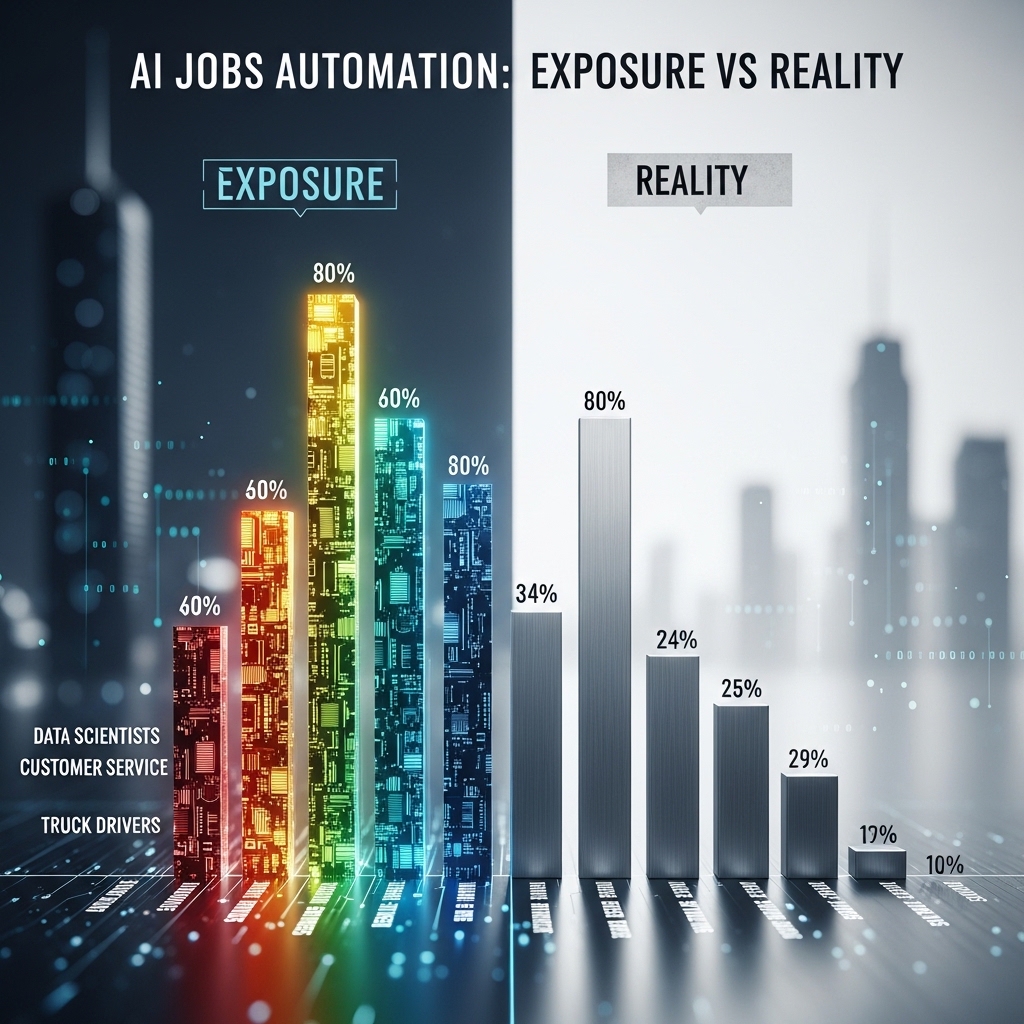
Many headlines imply that AI will eliminate entire professions. However, the research shows a more complex pattern.
AI currently assists with tasks rather than fully replacing workers.
Key Difference
| Factor | AI Exposure | Actual AI Automation |
|---|---|---|
| Definition | Tasks AI could perform | Tasks AI is currently performing |
| Example | Writing software code | Suggesting code snippets |
| Impact | Potential disruption | Productivity enhancement |
| Timeline | Long-term | Already happening |
This distinction is crucial.
Even though 94% of computer-related roles are exposed to AI jobs automation, only a fraction of those tasks are currently automated in practice.
Why Computer Jobs Have the Highest AI Exposure
Computer-related professions naturally sit at the center of AI development.
The tasks involved are:
- Digital
- Structured
- Data-driven
- Language-based
These characteristics make them ideal for AI models trained on vast datasets.
For example:
Tasks AI Handles Well
- Code generation
- Bug detection
- Technical documentation
- Data pattern analysis
- API integration suggestions
Tools like <a href=”https://openai.com/chatgpt” target=”_blank”>ChatGPT</a> and <a href=”https://github.com/features/copilot” target=”_blank”>GitHub Copilot</a> already assist developers daily, dramatically speeding up workflows.
However, complex architecture design, strategic decision-making, and system thinking remain largely human-driven.
Industries Most Affected by AI Jobs Automation
The study categorized professions based on their level of AI exposure.
Here is a simplified breakdown.
| Industry | Estimated AI Exposure |
|---|---|
| Computer & Mathematical | 94% |
| Legal Services | ~90% |
| Management | ~70% |
| Architecture & Engineering | ~65% |
| Arts & Media | ~60% |
| Construction | Near Zero |
| Grounds Maintenance | Near Zero |
This data aligns with broader labor market research from the <a href=”https://www.mckinsey.com/mgi” target=”_blank”>McKinsey Global Institute</a>, which predicts that AI will transform knowledge work much faster than physical labor sectors.
That means jobs involving thinking, writing, analyzing, and planning will feel AI’s impact sooner than manual labor roles.
Why the Automation Gap Still Exists
Despite the high exposure numbers, full AI automation is still limited.
Several barriers slow down the transition.
1. Trust and Reliability
Businesses cannot risk critical systems being managed entirely by AI.
Even advanced models occasionally produce incorrect outputs.
2. Context and Judgment
AI lacks real-world context.
Complex decisions often require human intuition and experience.
3. Legal and Ethical Constraints
Industries like law, finance, and healthcare require strict regulatory compliance.
AI still operates under supervision in these fields.
4. Organizational Adoption
Many companies simply have not integrated AI deeply into their workflows yet.
Adoption is happening, but it takes time.
What This Means for Developers and Tech Professionals

The biggest mistake professionals can make is assuming AI will simply replace them.
History shows that technology tends to augment workers rather than eliminate them completely.
Consider the evolution of programming tools.
From assembly language to modern frameworks, each advancement reduced manual effort but increased productivity.
AI represents the next step in that progression.
Developers who understand AI-assisted workflows will likely become far more productive than those who resist the change.
Skills becoming increasingly valuable include:
- AI-assisted coding
- Prompt engineering
- System architecture design
- AI tool integration
- Data interpretation
Instead of replacing developers, AI may increase demand for highly skilled engineers who know how to use it effectively.
Jobs That Are Surprisingly Safe (For Now)
Interestingly, the study shows that several professions have almost zero AI exposure.
These roles require physical presence, environmental adaptation, or complex manual work.
Examples include:
- Construction workers
- Electricians
- Plumbers
- Landscapers
- Mechanics
These jobs involve unpredictable physical environments where AI and robotics still struggle.
Ironically, some of the most “future-proof” careers may lie outside traditional office roles.
The Bigger Picture: AI as a Productivity Multiplier
Instead of framing the conversation as AI versus humans, it may be more accurate to view AI as a productivity amplifier.
When used correctly, AI tools allow professionals to:
- Complete tasks faster
- Reduce repetitive work
- Improve accuracy
- Focus on creative and strategic thinking
This shift could dramatically reshape industries.
Rather than replacing entire professions, AI may compress the number of workers needed for certain tasks while increasing the value of highly skilled experts.
What Professionals Should Do Right Now
The smartest strategy is not panic — it is preparation.
Professionals who adapt early will benefit the most.
Key steps include:
Learn AI Tools
Become comfortable using AI systems in daily workflows.
Focus on Human Skills
Critical thinking, leadership, and creativity remain difficult for AI to replicate.
Build Hybrid Expertise
The future belongs to professionals who combine domain expertise with AI fluency.
For example:
- Marketers using AI analytics
- Developers building AI systems
- Designers leveraging generative tools
The Real Question: Transformation, Not Replacement
The most important takeaway from the research is this:
AI jobs automation does not automatically mean job elimination.
Instead, it signals a massive transformation in how work is done.
Just as the internet reshaped entire industries, AI is now redefining productivity and knowledge work.
The professionals who thrive will be those who adapt faster than the technology evolves.
Labor market impacts of AI: A new measure and early evidence
Conclusion
The statistic that 94% of computer jobs are exposed to AI sounds alarming at first glance.
But the reality is more nuanced.
AI is not instantly replacing software engineers, analysts, or designers.
Instead, it is reshaping the tasks within those roles.
The gap between potential automation and real-world adoption still exists, but it is shrinking rapidly.
Over the next decade, AI will likely become an essential partner in nearly every knowledge profession.
The question is no longer whether AI will change work.
The real question is how quickly individuals and organizations will adapt to AI jobs automation.