

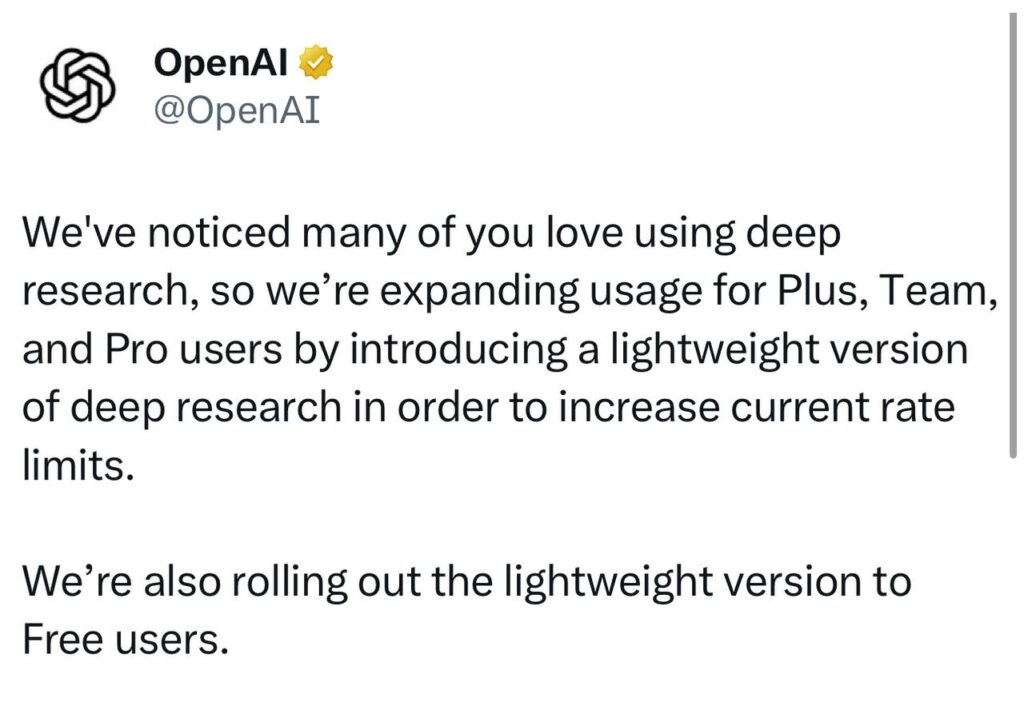
OpenAI updates 2025 : In April 24, We’re significantly increasing how often you can use deep research—Plus, Team, Enterprise, and Edu users now get 25 queries per month, Pro users get 250, and Free users get 5. A new lightweight version of Deep Research, powered by o4-mini, makes this possible while staying cost-efficient and maintaining high quality. Once you reach your limit for the full version, your queries will automatically switch to the lightweight version.
February 25, 2025 update: All Plus users can now use deep research.
February 5, 2025 OpenAI updates: Deep research is now available to Pro users in the United Kingdom, Switzerland, and the European Economic Area.
Today we’re launching deep research in ChatGPT, a new agentic capability that conducts multi-step research on the internet for complex tasks. It accomplishes in tens of minutes what would take a human many hours.
OpenAI updates 2025
Deep Research is OpenAI’s next agent that works independently. You provide a prompt, and ChatGPT finds, analyzes, and synthesizes hundreds of sources. The result is a detailed report at the level of a research analyst. It runs on a version of the upcoming OpenAI o3 model, optimized for web browsing and data analysis. This system uses reasoning to search, interpret, and process large volumes of text, images, and PDFs online. It also adapts to new information as it appears.
The ability to synthesize knowledge is a prerequisite for creating new knowledge. For this reason, deep research marks a significant step toward our broader goal of developing AGI, which we have long envisioned as capable of producing novel scientific research.
Why we built deep research
OpenAI Updates 2025 introduces Deep Research to help professionals in finance, science, policy, and engineering. It delivers information that is thorough, precise, and reliable. Moreover, it is equally useful for shoppers who want personalized recommendations on big purchases. These often include cars, appliances, and furniture that normally require careful research. In addition, each output provides full documentation, clear citations, and a reasoning summary. This makes it easy to reference and verify. Furthermore, Deep Research is highly effective at finding niche and non-intuitive insights across the web. As a result, it saves valuable time by managing complex and time-consuming research with just one query.
Deep Research works independently to discover, reason, and consolidate insights from the web. To achieve this, it was trained on real-world tasks that required browser and Python tool use. It also relies on the same reinforcement learning methods behind OpenAI o1, our first reasoning model. Although o1 shows strong skills in coding, math, and other technical areas, real-world challenges often need broader context. Many of these tasks demand information gathered from diverse online sources. Therefore, Deep Research builds on o1’s reasoning capabilities to close this gap. It can now handle the kinds of problems people face in both work and everyday life.
How to use OpenAI updates 2025 deep research
In ChatGPT, select ‘deep research’ in the message composer and enter your query. Tell ChatGPT what you need—whether it’s a competitive analysis on streaming platforms or a personalized report on the best commuter bike. You can attach files or spreadsheets to add context to your question. Once it starts running, a sidebar appears with a summary of the steps taken and sources used.
Deep research may take anywhere from 5 to 30 minutes to complete its work, taking the time needed to dive deep into the web. In the meantime, you can step away or work on other tasks—you’ll get a notification once the research is complete. The final output arrives as a report within the chat – in the next few weeks, we will also be adding embedded images, data visualizations, and other analytic outputs in these reports for additional clarity and context.
Compared to deep research, GPT‑4o is ideal for real-time, multimodal conversations. For multi-faceted, domain-specific inquiries where depth and detail are critical, deep research’s ability to conduct extensive exploration and cite each claim is the difference between a quick summary and a well-documented, verified answer that can be usable as a work product.
Know More about : OpenAI